
A carabiner only works because it is missing something. The gate does not close on itself. It needs a ring, a bolt, another piece of metal to snap into. Alone, it is just a curved piece of steel. Together with the right ring, it can hold a climber’s full weight off the side of a mountain.
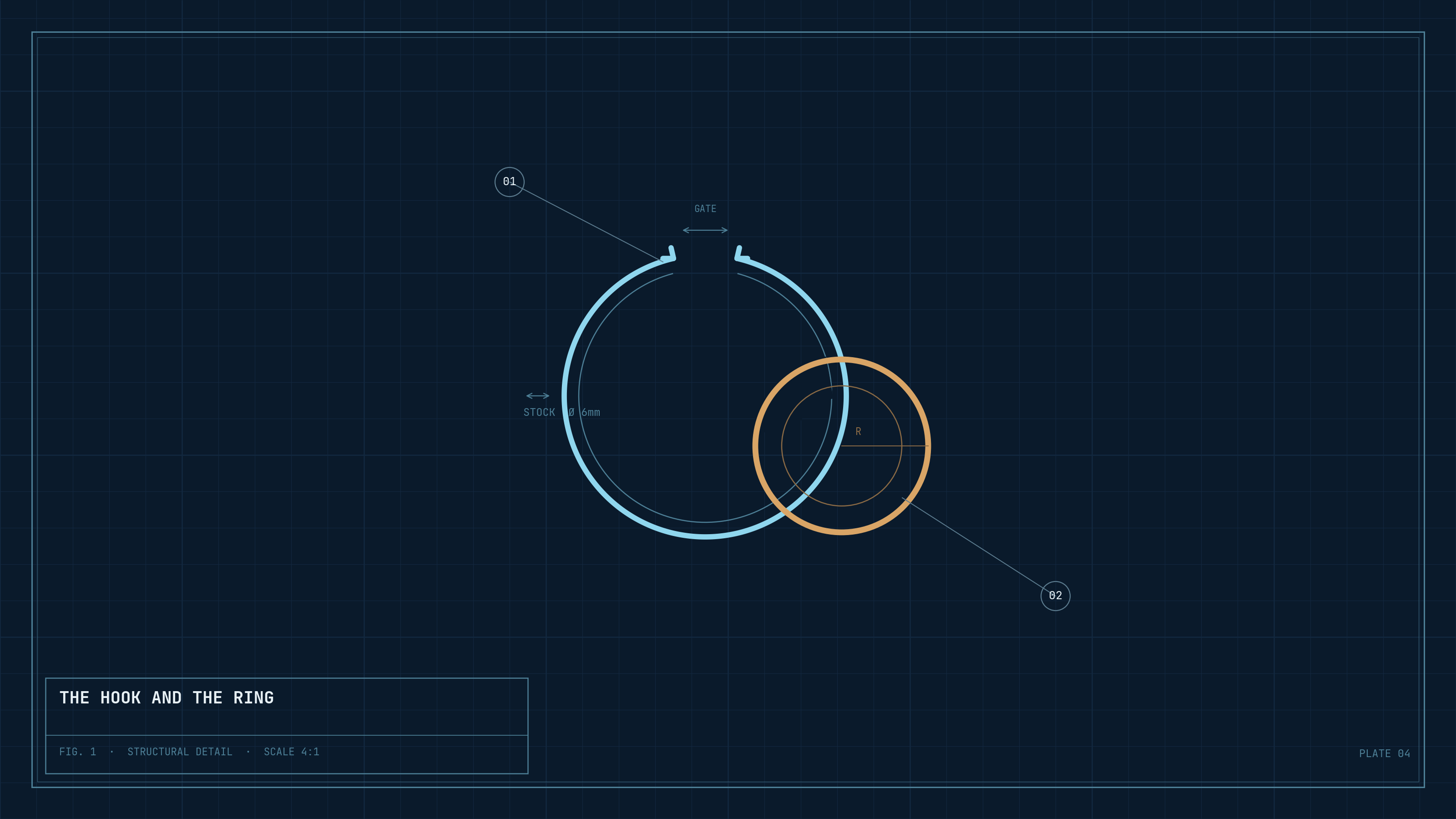
I think about this shape a lot lately, because I see it everywhere in how we build things, and in how we build careers.
No engineer, no leader, no team is complete on their own. We are all looking for the ring that closes our gate. A mentor. A team. A tool. A company that finally lets us do the work we always knew we could do. And here is the part that took me years to really see: the same mechanism that completes you can also be the thing that traps you. The hook does not know the difference. It just closes.
The good kind of incastro
I have spent years as an engineering leader, building products and teams long before AI entered the picture. More recently, on a new project called ARTEX, I have gone deep on AI coding tools like Cursor, Codex, Antigravity, GitHub Copilot, Claude Code. Each one has its own strengths, its own blind spots. None of them replace the engineer. What they do is close a gap that used to take a small army to close. Suddenly one person with a clear mental model can move at a pace that used to require a team of ten.
That is a hook finding its ring in the best possible way. The tool gives you speed and reach. You give the tool judgment and taste. Neither piece is enough alone. The AI cannot tell you if the architecture is right, if the direction serves the product, if this is the version worth shipping. You cannot type fast enough to build it all by hand anymore, not at the pace the market now expects. Put together, something holds that neither could hold alone.
The same is true of a good team, or a good mentor. When it works, you come out of the relationship more capable, not less. You borrow their pattern recognition for a while, and eventually it becomes yours. The good incastro, the good interlock, always lets go when it is done its job. It leaves you bigger than it found you.
The kind that quietly takes over
But the same shape can close the wrong way, and from the outside it looks almost identical at first.
I have watched engineers let a tool make architecture decisions nobody is really reviewing, not because the tool is bad, but because they got attached to it. The suggestion came fast, it looked clean, it shipped, and somewhere in there the human stopped asking if it was actually right for the product or the business. That is the real failure. It is never the tool. A tool has no opinion about your product, your users, or your company. The moment we let our attachment to a tool, a process, or a way of working make the call for us, we have handed over the one thing that was never the tool’s job to hold.
I have seen leaders build teams that cannot function without them in every room, and call it good management, when really it is a dependency dressed up as leadership. I have seen people cling to one company, one title, one identity, long after it stopped fitting, because letting go felt like losing a part of themselves.
The test is simple, even if living it is not: after the good interlock, you feel more capable. After the bad one, you feel smaller, and a little more stuck than before. Craft that leans on a tool still grows. Craft that gets replaced by attachment to a tool quietly disappears, and you often do not notice until someone asks you a question you can no longer answer without it.
What holds, and what just closes
This is why context, critical thinking, and curiosity matter more now, not less. As these tools get better at closing gaps for us, the real differentiator stops being who has access to the sharpest tool. Everyone will have access. It becomes who still has the judgment to catch the moment attachment starts making the call instead of them.
It is never the tool’s fault, and it is never really about the tool at all. What makes the right call on architecture, on product, on the business, is the same thing it always was: critical thinking, awareness of what you are actually building and for whom, curiosity to keep questioning your own choices, and staying open enough to change course when the evidence says you should. The tool can carry you fast in a direction. Only you can tell if it is the right one.
The accumulated experience, the principles you have built over years of shipping real things with real teams, does not shrink in value as AI gets stronger. It becomes exactly the thing that decides whether a fast tool is being used well or badly. Collaboration matters more too, not less, because a team that thinks together, openly and critically, catches the bad interlock faster than any one person alone.
None of this is a reason to slow down or hold the tools at arm’s length. It is a reason to stay awake while you use them. Build the habit of asking, every so often: am I making this call, or is my attachment to the tool making it for me.
The gate is always going to want to close on something. The work of a career is learning to tell the difference between the ring that lets you go when you are ready, and the one that never planned to. Get that right with a tool, and you have gotten it right with almost everything else that ever tries to complete you.